

What’s more important: sticking to global standards or maintaining internal consistency?
The paradigm of naming conventions in software
If you code, have ever dipped your toes in the amazing(ly vast and diverse) world of coding, or have simply been curious enough to look at the browser tab where the webpage name is, you might have noticed that, usually, there-is-something-like-this, ie. words separated by a hyphen. For your next trivia night, I’ll tell you that this is called kebab-case 🙂
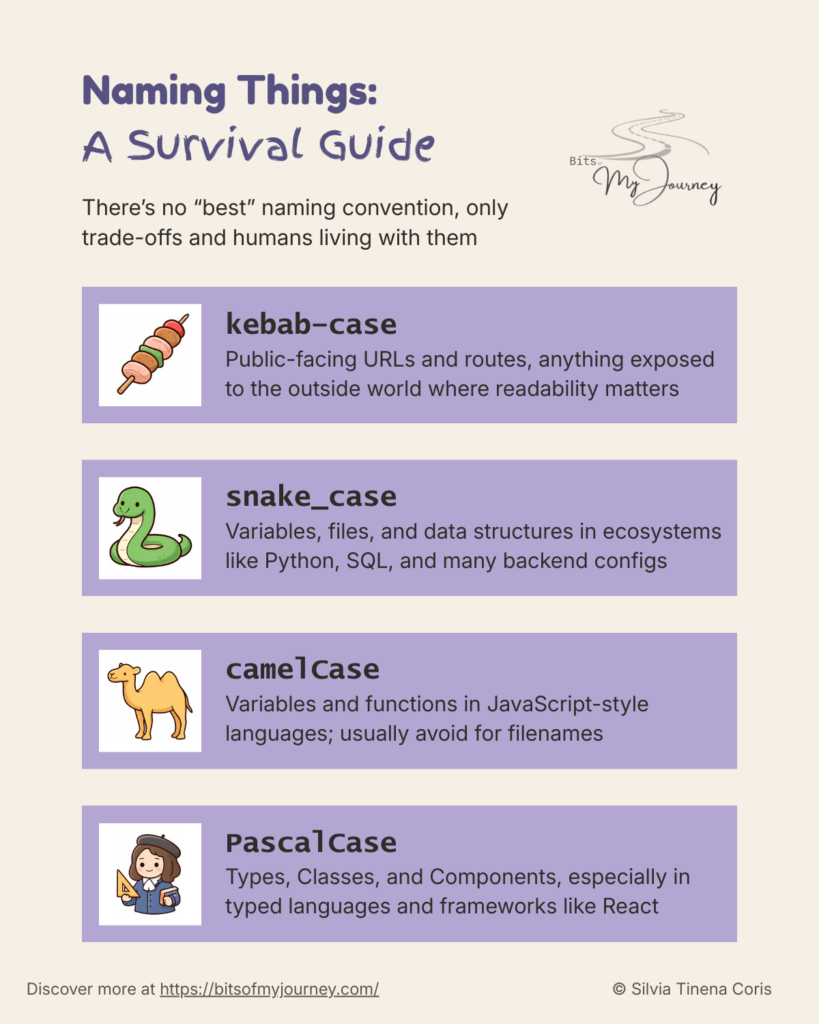
However, in software and firmware development, we don’t always use kebab-case (how boring would it be if there was only one standard, right?). In fact, there are four different ways of writing variables, each with a name funnier than the last:
kebab-casesnake_casecamelCasePascalCase
With a little bit of imagination, and if you squint your eyes, you can somehow see the logic behind some of these names.
kebab-case has got hyphens in between the words, just how we put meat and vegetables in a skewer to form a kebab (or a “pincho”, but I guess kebab was easier to pronounce!)
camelCase reminds us of the humps in a camel. However, and this has always puzzled me… A camel has got two humps, whether a dromedary only has one (another trivia fact for you, I’m on fire today!). Therefore, shouldn’t this be called dromedaryCase? Again, maybe it’s too complicated to pronounce 😉
Because I could NOT mention this… I learnt about dromedaries only having one hump and camels two in Asterix and Cleopatra, a brilliant cartoon film from 1968 (I wasn’t born then!) in which Cleopatra and Julius Caesar bet on building a palace in 3 months.
I’ll leave finding the logic behind snake_case and PascalCase as an exercise for the reader, since I can’t really find it! Please enlighten me in the comments if you can, I’d really love to read you.
I’ve created an infographic with cute visual images and the uses of each convention below: ⬇️
Alright, let’s get back to the question in hand!
Consistency vs Standards
I’ve recently been working on an internal project where, historically, page URLs have been named using camelCase: /thisIsAPage
From a readability and web-standards point of view, this isn’t ideal. For URLs, the widely accepted convention is kebab-case: /this-is-a-page
It’s lowercase, hyphen-separated, and easier to scan. It’s friendlier for humans and search engines alike. By almost every “official” metric, the kebab-case version is “better.”
But here’s the catch: this is an internal project.
The Reality of Technical Debt
The existing URLs are already consistently using camelCase. They’re referenced in our documentation, embedded in our tests, and likely etched into the team’s muscle memory.
Changing the convention now wouldn’t just be a stylistic improvement; it would introduce churn. It would create a period of inconsistency where some routes are “new” and others are “legacy,” leading to a steady stream of tiny, frustrating “why is this one different?” moments.
One of my core software engineering lessons is:
Consistency beats standards
Not because standards don’t matter, but because consistency reduces cognitive load. When a system is predictable, no one has to stop and think about naming conventions when they should be focusing on logic, data, or user needs.
A working rule of thumb
Inside a closed, internal system
- Consistency wins
- Avoid the churn
At the edges
- For public URLs, APIs, or contracts with the outside world:
- Use standards
Naming conventions aren’t just about being “right.” They’re about helping humans move through systems with the least possible friction. Sometimes that means choosing the “worse” technical option so the team can sleep better at night. And that’s OK.
Leave a Reply